
Your roof is essential to the long-term maintenance of your house. A well-functioning roof protects the structure, cladding, foundation, landscape, and hardscapes. It’s also integral to the building envelope and thus affects comfort, air quality, and energy efficiency. The industry estimates that approximately 80% of all U.S. homes have some type of asphalt shingle on them.
Still, there are many other options, including composite, metal, wood, tile, and slate. Let’s consider and the pros and cons of these various materials for your next roof replacement.
Important Factors to Consider
An effective way to determine the best roof for your house is to schedule an on-site inspection and consultation. An experienced roofer can help you explore the various materials within the context of your preferences and your home’s needs.
Budget
A budget is an excellent starting point because it will narrow down the options for you. You don’t necessarily have to pay for the new roof out of pocket. There are flexible financing options available. Often, it’ll come down to what you’re comfortable paying.
Climate, Longevity, and Total Cost of Ownership
Another consideration is the manufacturer’s expected lifespan for the material. You can purchase roofing materials that manufacturers have rated for 15, 25, or 40 years, and even longer. If you choose a 30-year rather than a 15-year shingle, that product can last twice as long with proper maintenance.
You won’t have to worry about reroofing your home as soon. The total cost may be lower as well, which is often what makes higher-end products worthwhile. You must also factor in your local climate. A basic asphalt shingle will often last 15 years or longer in a mild climate. In an area that experiences harsh winters, on the other hand, it may only last 10 years.
Standard and Extended Warranty Protection
Most roofing materials include a standard manufacturer’s warranty that protects you against manufacturing defects. Note that the standard warranty can differ based on the installation. Some brands, for instance, reserve their top warranties for factory-certified installers.
Often, those top warranties will cover labor and other aspects beyond manufacturing. Many brands offer extended warranties as well. They let you spend more at purchase and, in some cases, afterwards to extend and/or broaden the warranty protection.
Curb Appeal
Your house’s roof is a key aspect of its appearance and value. Switching to a different roofing material can dramatically transform the home’s aesthetic. Some homeowners prefer a handsome yet reserved roof that helps highlight other aspects of the house. Others prefer a roof that demands attention and stands apart from the other materials in the neighborhood.
Depending on the material, there might be a range of colors and textures to choose from. Often, the higher the price, the more options you’ll have. Basic shingles may be available in several colors, while luxury shingles come in custom options.
The Home’s Architectural Style
Some roofing materials better complement certain architectural styles than others. Shingle roofs are often the preferred choice for traditional ranch homes. Homes with complex roofs look nice in colors, shadows, and textures that accentuate complexity. If you have a home with a style of a particular period, roofing materials of that time often work best. Slate is a popular choice for Victorian homes, for instance, but so is cedar, clay, and even copper.
Energy Efficiency
As mentioned, a roof is an integral aspect of a house’s building envelope. You can achieve a tight building envelope with any of the roofing materials discussed. That said, some materials are best suited to specific scenarios. Cool roofs are an increasingly popular option for homes that get substantial direct sunlight. It’s generally best to choose a light color that doesn’t absorb as much heat. There are also architectural and composite shingles available with reflective qualities that help keep the roof and attic cooler.
Asphalt Shingles
Asphalt shingles are the most popular roofing material in North America. The basic asphalt shingle, often referred to as a 3-tab shingle, is relatively inexpensive and can last 15 years. Their popularity is largely due to the balance between performance and longevity. Still, architectural shingles, also referred to as laminated shingles, continue to gain market share with each passing year.
They have additional layers that provide impact resistance, energy efficiency, and longevity. Many brands classify some of their architectural shingles as luxury shingles. That’s where you’ll find cool shingles and similar products. You’ll also find additional colors and textures, including shingles that mimic other roofing materials, such as slate.
Roof Coatings
If you have asphalt shingles, protective roof coatings can help them last much longer. Coated roofs will require less maintenance and fewer repairs as well. However, they’re not compatible with all roofing types. If you replace your roof with asphalt shingles, consider a protective coating to help ensure your new roof lasts as long as possible.
Composite Shingles
Composite or synthetic shingles are an increasingly popular alternative to asphalt shingles. A laminated shingle is technically a type of synthetic shingle. Still, the industry generally reserves this category for shingles made from materials like polyethylene or polyurethane.
The design process allows for many more colors and styles than you’ll find even with architectural shingles. Refinement of the process has led to composite shingles that can last 50 years or longer. Brands can also adjust the formula for better efficiency and protection depending on the climate.
Metal Roofing Systems
Metal roofing has fallen in and out of popularity over the years in the U.S. It was once popular because it was effective and relatively inexpensive. Metal roofing popularity is on the rise again since the turn of the century. That has a lot to do with the evolution of the standing seam roof design. Modern metal roofs are beautiful and available in numerous colors. Aluminum and galvanized steel are the most common options and generally last about 50 years. Zinc and copper are premium options that can last 100 years or more.
Wood Shingles and Shakes
Less than 10% of U.S. homes have a wood roof. The most popular material among them is cedar, which is available as shingles and shakes. Shingles give a house a more uniform aesthetic. The rough-hewn shakes give it a more rustic aesthetic. Another notable aspect of cedar is that it matures as it ages and becomes more beautiful.
Tile Roofing
Consumers tend to associate tile roofing with the Mediterranean style. Yet, brands make them in many styles and colors that are quite different from that classic aesthetic. Clay is the traditional choice, but it isn’t ideal for all climates. In harsher climates, concrete tile roofing is often a more cost-effective alternative.
Slate Roofing
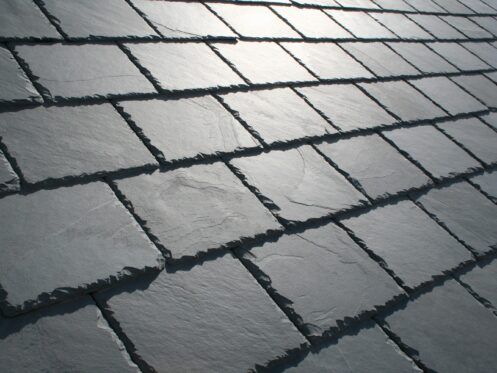
Slate roofing is heavy and expensive, but it’s distinct, elegant, and long-lasting. There are two classes of slate used for homes: soft and hard. Soft slate isn’t as heavy and lasts 50-70 years, while hard slate can last 100 years or more.
Flat Roofs
Some modern homes have fully low-pitch or “flat” roofs. Many other homes have traditional roof designs with low-pitch areas mixed in here and there. For these areas, you must use materials traditionally associated with commercial roofing. That includes materials like TPO and EPDM.
Professional Roof Installation in Idaho, Oregon, and Washington
Jimmy's Roofing is a roofing contractor with four locations. Our team serves the Spoken area from Spokane Valley, WA, and the Seattle area from Kirkland, WA. We serve the Portland area from Clackamas, OR, and the Coeur d’Alene area from Coeur d’Alene, ID. Our team installs many different roofing materials in these regions, including asphalt, composite, metal, wood, tile, and slate.
To schedule an on-site consultation, call us today or contact us online.



 #thejimmysWAY