
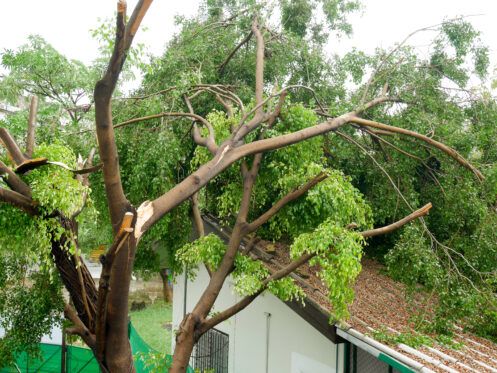
From wildfires and major hailstorms to tornadoes and hurricanes, severe weather is becoming increasingly common across many parts of the country. One of the biggest risks to your home during severe weather is roof damage. Storm damage is the main reason why certain types of roofs can fail prematurely. While no roof can ever be fully resistant and impervious to damage, the options outlined here are among the best at standing up to storms and severe weather.
Metal Roofing
Metal roofing is by far one of the best options when it comes to resisting wind and impact damage. While unusually large hailstones or larger pieces of flying debris still have the potential to dent metal roofing, a metal roof can stand up to impacts far better than almost every other option. Most metal roofing is also designed to withstand wind speeds of anywhere from 120 to 160 miles per hour. The wind resistance of a metal roof is contingent on it being installed correctly, but this is generally true for all types of roofs.
Metal roofing also performs extremely well in terms of drainage and withstanding heavy rains and snowfall without leaking. The metal sheets are usually cut to the correct length by the manufacturer before being shipped to the site. That means you have single sheets the full length of the roof slope from the peak down to the eave, ensuring that water flows straight off into the gutters. Even if there is a large amount of snow on a metal roof, it will usually slide off as soon as it starts to melt. The issue with shingles and tiles is that they’re installed in overlapping rows, which can create a risk of water seeping underneath them and the roof potentially leaking.
Metal roofing does require a higher investment than a shingle roof, but it also has some significant advantages other than just performing better in severe weather. One is that it is much more flame resistant and shouldn’t catch on fire even if lightning strikes the roof. Another is that it has a much longer lifespan. Shingle roofs usually don’t last for more than 20 to 30 years. A properly installed metal roof will usually last for at least 40-50 years, and some can even last upwards of 70 years with only minimal maintenance.
Slate Roofing
If you’re looking for a classic, timeless look combined with exceptional strength, durability and longevity, a slate roof is a great choice. Slate roofing is generally on par with metal roofing in terms of storm damage resistance. While larger impacts can still crack slate tiles, they still stand up fairly well. It’s also fairly easy for experienced roofers to replace any damaged tiles without needing to pull many of the others up.
Slate roofs are fairly resistant to wind damage due to how heavy they are, and are typically rated to handle wind speeds of up to 110 miles per hour or so without any issues. The drawback is that the roof needs lots of extra reinforcement to carry all of the weight. A slate roof is already by far the most expensive option, and needing to reinforce your roof before installing the tiles further adds to the cost. On the plus side, a well-maintained slate roof that was properly installed should last for 100 years or more. Installing this type of roof will increase the value of your home considerably compared to any other option as well.
Slate roofing also provides excellent drainage. This is especially the case for roofs with a steeper pitch or slope. The steeper the slope, the more the tiles overlap the row below them and the less chance there is of water getting underneath them.
Concrete and Clay Tiles
Concrete and clay tiles can stand up to extreme winds just as well as metal roofing, but this is again because of how heavy they are. Tile roofs provide a high level of insulation, making them a good option for places that experience extreme heat. While tile roofs typically don’t last as long as slate, they usually still last for 70+ years. As with slate, the downsides to tile roofs are the weight and the cost.
The one area where tile roofs don’t perform as well is in resisting impact damage. Clay tiles are fairly brittle and can get cracked or broken by hail, tree branches or even just by walking on them incorrectly. Concrete tiles are a bit stronger, but they still aren’t nearly as impact resistant as slate or metal roofing.
Impact-Resistant Asphalt Shingles
Standard asphalt shingles are the most likely to get damaged by hail and flying debris. They’re also susceptible to uplift from strong winds, which can result in some of them breaking or getting ripped off the roof.
Class 3 and Class 4 impact-resistant asphalt shingles can stand up better to severe weather. Class 3 shingles are designed to handle the impact of up to 1.75-inch hailstones without cracking, breaking or getting dented. Class 4 shingles should be able to handle the impact of hailstones up to 2 inches in diameter with no issues. Most impact-resistant shingles also have higher wind-resistance ratings than standard asphalt shingles, as many are rated to withstand 110 mph winds. What makes them different from standard shingles is that they are thicker and have additional rubbers or polymers that make them stronger and more flexible.
The main drawback to impact-resistant shingles is that they are quite a bit more costly than standard shingles. Nonetheless, they can be worth the price, as your roof will usually last longer and be less likely to need repairs over its lifespan. The other thing to note is that many homeowners insurance companies provide discounted premiums for houses with impact-resistant shingles. Some companies only provide around a 5% discount, while others offer discounts of anywhere from 20-35% for Class 4 shingles.
Composite Shingles
Composite or synthetic shingles are made from various types of rubbers, plastics and polymers and are much stronger and more durable than asphalt shingles. Many products have Class 3 or 4 impact-resistance ratings and can handle winds of around 120 miles per hour. The longevity of composite shingles doesn’t quite compare to metal, slate and tiles, but most roofs should last for 40-50 years.
Many composite shingles are designed to mimic the appearance of natural roofing materials, like slate, clay or wood. This allows you to achieve the same look without the added weight of tiles or the flammability of wood shake shingles.
Composite shingles can be a great option for eco-conscious homeowners as well. Most products are made using recycled materials. While the percentage varies from product to product, some contain up to 95% recycled materials.
Reach Out to the Experts
If you’re unsure of which roofing option is right for your home or business, the experts at Jimmy's Roofing can advise you and assist you in making the right choice. We install and repair asphalt shingles, cedar shake shingles, metal roofing, slate and tiles, and we work with trusted manufacturers like GAF, Owens Corning, Johns Manville, Duro-last, Versico and more. We also specialize in roof coatings, which can extend the life of an existing roof and make your roof less prone to damage and leaks.
For premier roofing services in Portland, Spokane, Seattle, Coeur d’Alene or any of the surrounding areas, contact Jimmy's Roofing to protect your home from harsh weather.








 #thejimmysWAY